

.png)
.svg)


Scaling Menopause Care Through CBT and Digital Support
Read our full published article with Dr. Hunter.
Want to learn more about implementing digital-first health solutions?
.png)

Tackling the physical and mental burden of menopause
For women with bothersome menopause symptoms, the impact goes well beyond the physical. Psychological distress, disrupted sleep, and difficulty concentrating can make it harder to perform at work, harder to parent or care for family, and can erode quality of life more broadly.
Compounding this is the experience of navigating the healthcare system itself. Women who do seek help often describe feeling dismissed or told their symptoms are being imagined [4]. Healthcare providers may under-recognize menopause due to training gaps and limited institutional incentive to address it [5]. Layer on the stigma and embarrassment that still surrounds the topic, plus its knock-on effects at work and at home, and it's easy to see why some women disengage from care altogether.
Perhaps the central problem is how we talk about menopause as a society. Its complexity is often reduced to incomplete and undermining binaries: just a natural process or a simple biological problem; symptoms that are "due to your hormones" or symptoms that are "all in your head." This framing ignores women's lived experience, and it shapes real treatment decisions.
Mixed beliefs about some of our most effective tools for treating menopause symptoms — CBT and menopause hormone therapy (MHT) — are held by patients and clinicians alike, and create a genuine barrier to access [5,4]. Many healthcare providers are unaware of how CBT actually works for menopause symptoms, and without proper framing, women offered CBT can hear a genuine treatment recommendation as confirmation that their symptoms aren't being taken seriously.
This isn't unique to CBT. MHT remains underused, and much of the fear traces back to a single 2002 study that linked it to increased breast cancer and cardiovascular risk. But that study tested one specific oral formulation in women averaging 63, well past the onset of menopause. Later reanalyses tell a different story for women starting treatment nearer menopause itself: for most healthy women under 60, or within ten years of their last period, the benefits generally outweigh the risks. But what remains an issue is that even when MHT is prescribed and used, the treatment plan is rarely holistic and not adequately addressing the broader clinical needs of the patient from a biopsychosocial perspective.
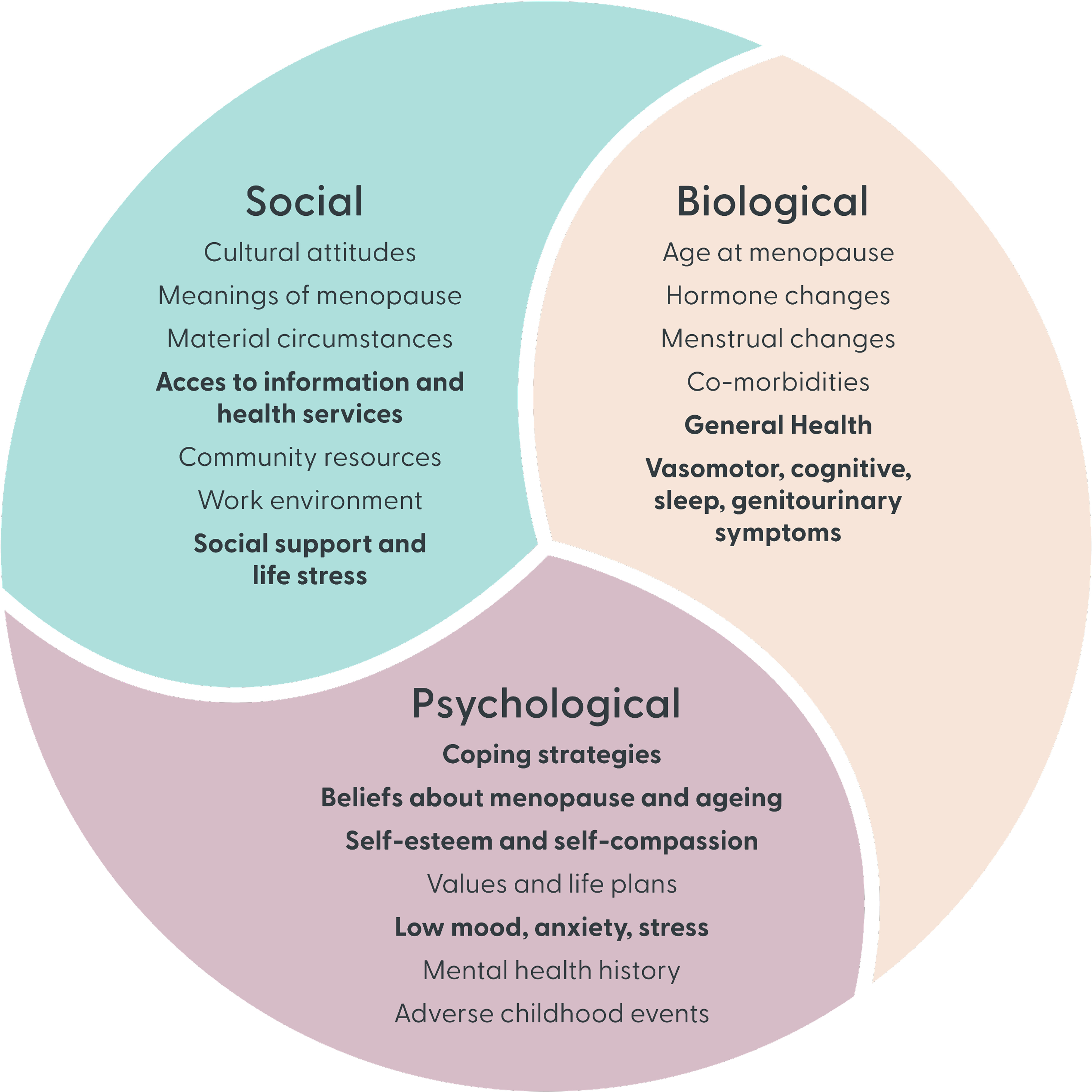
Collectively, these perceptions and beliefs are barriers to access. But the good news is that perceptions can change. The key is to reframe the menopause journey through an evidence-based biopsychosocial lens.
A new approach
There's a more accurate story we can tell about menopause support, and it isn't new; George Engel proposed the biopsychosocial model of health back in 1977 [7]. Applied to menopause, it recognizes that symptom burden is shaped not only by hormonal change but by health beliefs, coping strategies, lifestyle and sociocultural context, all interacting with each other.
There's a biological rationale for this. Deep within the brain, the hypothalamus acts as the body’s internal thermostat, with specialized neurons continuously monitoring temperature and coordinating finely tuned feedback mechanisms to maintain stability. Estrogen helps keep the hypothalamic thermostat accurately calibrated.
During menopause, fluctuating and declining estrogen levels can disrupt these temperature-regulating pathways, making this thermostat more sensitive. As a result, a tiny change in body temperature that would previously have gone unnoticed can be interpreted as overheating, triggering a sudden rush of heat, sweating, and flushing. Psychological stress can amplify this response by activating the sympathetic nervous system, increasing adrenaline and heightening the body’s arousal state.
In turn, the discomfort of a hot flush can reinforce this stress response, creating a self-perpetuating cycle. This is why both hormonal and psychological interventions have a legitimate, evidence-based role in menopause care. They aren’t competing approaches, but complementary strategies that target different parts of the same interconnected biological system.
Where there’s space for menopause-specific CBT
CBT for menopause is not generic talk therapy, and it isn't a way of implying symptoms are "all in your head." It's a structured, evidence-based intervention built on a few core components. Women learn to identify and reframe the unhelpful thoughts that often accompany the biologically driven hot flushes and night sweats.
For example the embarrassment, the catastrophizing and the fear of judgment, which can otherwise amplify the stress response and feed the very cycle described above. Paced, diaphragmatic breathing is taught as a practical tool to calm that stress response in the moment. CBT-based behavioral strategies target sleep disruption directly, and coping skills and self-compassion practices help women manage symptoms day to day.
None of this changes hormone levels, it changes how the brain and body respond to the same physiological trigger, which is exactly why CBT works on its own and alongside MHT.
The evidence backs this up. Menopause-specific CBT is recommended by major bodies including the International Menopause Society, The Menopause Society and NICE, as a stand-alone treatment or alongside MHT [8-10]. It has demonstrated clinically significant effectiveness for vasomotor symptoms, sleep disturbance, and low mood.
While the evidence is strong, access isn't. Menopause-specific CBT remains scarce, and many therapists have little specific training in it. Even when it is available, some women are reluctant to seek help through mental health services they don't feel represent their problem.
Scaling access with digital health
This is where digital therapeutics come in: evidence-based, app-delivered interventions that can extend the reach of CBT well beyond what in-person waiting lists allow, without requiring every provider or clinic to become a specialist overnight.
While Germany's DiGA framework is the most advanced example globally — a fully operational system for prescribing and reimbursing proven digital therapeutics — similar movements are on the rise elsewhere. In the US, digital health support has been a staple in health plan- and employer-provided care for more than 10 years.
At Sidekick, we specialize in building digital support that scales. Our prescription digital therapeutic for menopause, MENO! App, is built around menopause-specific CBT, alongside evidence-based education, symptom tracking and exercise support, each shown to improve the lived experience of bothersome symptoms. It's modular by design and grounded in empowerment, giving women a program suited to their own needs, and it looks beyond day-to-day symptoms to longer-term health, supporting women to age well and manage risks such as cardiovascular disease and fracture.
Results from a clinical study on MENO! App show the app is more than three times as effective at improving quality of life scores compared to control, and produced effect sizes comparable to those documented for MHT (based on an indirect comparison with published literature, not a head-to-head trial.)
In the US, our menopause program is available alongside +24 other common conditions as part of our multi-condition platform — we look forward to sharing outcomes from our US partners soon.
Final thoughts
Our goal isn't to replace hormone therapy or in-person care. It's to give women and clinicians another accessible, evidence-based option that fits alongside existing care options.
Hormone therapy, non-hormonal medicines, CBT, and lifestyle interventions are all safe, evidence-based tools. The best, most honest answer for most women seeking relief is some combination, chosen deliberately rather than by default. What's missing is the model of care that allows that choice: one grounded in a biopsychosocial understanding of menopause, built for scale, and structured so the right treatment reaches the right woman at the right time. That's the shift we're building.
References
- El Khoudary SR, Greendale G, Crawford SL, et al. The menopause transition and women’s health at midlife: a progress report from the Study of Women’s Health Across the Nation (SWAN). Menopause. 2019;26(10):1213–1227. doi:10.1097/GME.0000000000001424.
- Gatenby C, Simpson P. Menopause: physiology, definitions, and symptoms. Best Pract Res Clin Endocrinol Metab. 2024;38(1):101855. doi:10.1016/j.beem.2023.101855.
- Avis NE, Crawford SL, Greendale G, Bromberger JT, Everson-Rose SA, Gold EB, Hess R, Joffe H, Kravitz HM, Tepper PG, Thurston RC. Duration of menopausal vasomotor symptoms over the menopause transition. JAMA internal medicine. 2015 Apr;175(4):531-9.
- Martin-Key NA, Funnell EL, Spadaro B, et al. Perceptions of healthcare provision throughout the menopause in the UK: a mixed-methods study. Npj Womens Health. 2023;1(1):2. doi:10.1038/s44294-023-00002-y.
- Barber K, Charles A. Barriers to accessing effective treatment and support for menopausal symptoms: a qualitative study capturing the behaviours, beliefs and experiences of key stakeholders. Patient Prefer Adherence. 2023;17Dec 31:2971–2980. doi:10.2147/PPA.S430203.
- Engel GL. The need for a new medical model: a challenge for biomedicine. Science. 1977;196(4286):129–136. doi:10.1126/science.847460.
- Panay N, Fenton A, Hamoda H, et al. International Menopause Society (IMS) recommendations and key messages on women’s midlife health and menopause. Climacteric. 2025;28(6):634–656. doi:10.1080/13697137.2025.2585487.
- Shufelt CL, Brown V, Carpenter JS, et al. The 2023 nonhormone therapy position statement of the North American Menopause Society. Menopause. 2023;30(6):573–590.
- Martin-Key NA, Funnell EL, Bahn S. Treatment provision and management for the menopause: a multinational survey study. Front Glob Womens Health. 2025;6:1638428. doi:10.3389/fgwh.2025.1638428.
About the author

Andy Grannell, PhD
.svg)


.svg)
.svg)


.jpg)





.jpg)
.jpg)


.jpg)

.jpg)
.jpg)
.jpg)
.jpg)
.jpg)

.jpg)



.jpg)


.png)
.jpg)

.jpg)

%201%20(1).jpg)
.jpg)

.jpg)
.jpg)
.png)


.jpg)
%201%20(1)%201%20(1).jpg)
.jpg)


.jpg)
%201%20(1).jpg)
.jpg)
.jpg)
.jpg)
.jpg)
.jpg)

.jpg)

.jpg)
.jpg)


.jpg)
.jpg)

.jpg)
.jpg)
.jpg)

.png)

%201%20(1).jpg)


.png)
.jpg)
.jpg)
.png)
%201%20(1).jpg)
.jpg)
.jpg)
.jpg)


.jpg)

.jpg)
.jpg)
%201%20(1).jpg)

.jpg)

.jpg)
.jpg)


.jpg)
.png)

